_edited.jpg)
Future Scenarios: Different Forest Futures Across Europe
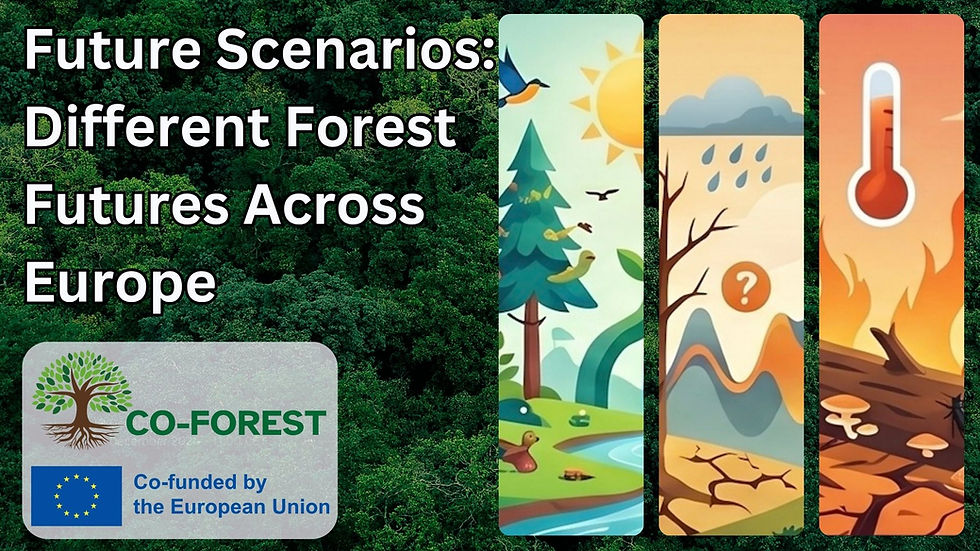
We are pleased to share that the CO-FOREST consortium has published its country-level Future Scenarios, a set of evidence-informed narratives that explore how European forests might develop over the coming decades under different climate and management conditions.
The scenarios were developed through a structured, participatory methodology drawing on two established approaches in futures thinking: morphological analysis and cross-consistency assessment, implemented through the Impact Pathway tool. The process began by identifying the key drivers of uncertainty most relevant to each national forest context, including climate variability, disturbance regimes, management practices, policy frameworks, and biodiversity pressures. Partners then defined plausible future states for each driver and assessed how these might interact and combine, filtering out internally inconsistent combinations to arrive at coherent, credible scenario pathways.
The result is three distinct scenarios for each partner country: an optimistic trajectory in which forests adapt and thrive, an intermediate pathway marked by persistent uncertainty and uneven outcomes, and a pessimistic trajectory in which climate pressures outpace the capacity of both ecosystems and management systems to respond. Crucially, each set of scenarios is grounded in the specific ecological, geographic, and institutional realities of its country, rather than applying a generic European template.
The five countries represented (Bulgaria, Estonia, Finland, Greece, and Lithuania) span a remarkable diversity of forest ecosystems, from Mediterranean landscapes under increasing fire and drought pressure to hemiboreal and boreal forests facing novel wind, pest, and soil instability challenges. This diversity makes the comparative picture especially valuable: while the broad trajectory of each scenario type is recognisable across contexts, the drivers, mechanisms, and implications differ in ways that matter for education, training, and policy.
These scenarios will feed directly into the next phase of CO-FOREST work, informing the identification of future skill gaps and the design of training content that prepares forestry professionals for the range of futures that may lie ahead.
The full scenario materials are available below.


